
NeverEnd
Wedding Production Agency
Wedding Venues on the Luštica Peninsula
Luštica is the peninsula that closes the entrance to the Bay of Kotor from the south. One side faces the sheltered water of the bay, the other faces the open Adriatic. Between them lie twenty kilometres of stone villages, olive terraces and empty coves, served by a single road. A wedding here is built differently from one in Kotor or Budva. There, the venue sits inside a town, and the town stays part of the day — passers-by, boats, the restaurant next door, the noise of the promenade. On Luštica the venue usually stands alone. You take the whole property, your guests sleep in it, and until evening there is nobody on site who is not yours. The second difference is distance. Tivat airport is 25–30 minutes from almost anywhere on the peninsula — closer than Kotor and considerably closer than Budva. The quiet paradox of Luštica is that Montenegro's most secluded stretch of coast turns out to be its most convenient one to fly into. Below: how the wedding venues on the peninsula are set up, what capacity each range really means, where to put a ceremony for Adriatic sunset views, and what a legal Montenegrin marriage takes on either side of the municipal line.
Luštica, Boka Bay or the Budva Riviera
Montenegro's three coastal regions produce three different wedding days. All three are beautiful. What separates them is what you get and what you give up. The Bay of Kotor is stone and history: Baroque towns, flat water, short drives between venues. In exchange, a narrow shoreline road, an early sunset behind the ridge and a lot of day-trippers in frame in July. See our Kotor and Boka Bay venues. The Budva Riviera is open sea, sand and infrastructure. Guests have somewhere to go before and after, there are more venues, and receptions can run larger. In exchange, resort noise and the feeling that the place is shared with everyone else on holiday. See Budva Riviera venues. Luštica is privacy. There are few venues, each stands on its own, and almost any of them can be taken on exclusive use. Couples seeking a private wedding tend to end up here for that one reason. Nobody walks through your ceremony, nobody sits at the next table. In exchange, there is no town around you: a pharmacy, a cash machine and somewhere to eat after the after-party all mean a drive to Tivat, and so do most of your suppliers. Put simply: couples go to Boka for the picture, to Budva for the movement, and to Luštica so the day belongs to them alone. Couples who want a large, high-energy reception are usually happier on the riviera. Couples who want twenty people, an olive grove and open Adriatic views belong here.
Two sides of the peninsula
A ridge runs down the middle of Luštica, and which side you are on decides your light, your wind and the character of the water. It is the first thing we establish when shortlisting.
The bay side: Krašići, Radovići, Luštica Bay
The northern shore looks inward, across to Tivat, Perast and the mountains opposite. The water is almost always flat here — there is no swell even when it is rough outside — so a ceremony can sit right at the waterline without anyone worrying about spray. The views here run across the water to Tivat and the mountains behind it. This is also where Luštica Bay is: a new marina town with a promenade and The Chedi hotel at its centre. It is the most urban point on the peninsula, with several restaurants and somewhere to go in the evening, while the nearest old village is five minutes away. In the neighbouring cove at Pržno, Almara Beach Club runs the largest beach club on Luštica, with a sandy entry into the water. The bay side has one drawback: the sun sets behind the Luštica ridge, which means behind you. There is no sunset shot with the sun in the water here. What you get instead is soft, diffused light and the mountains opposite lit up — many couples prefer it, but it is worth knowing before you book.
The open sea: Rose, Žanjice, Mirište
The western tip of the peninsula faces the mouth of the bay and the open Adriatic beyond it, and the views from here run out into open water with no facing shore. Rose is the oldest settlement in Boka — a line of seventeenth-century stone captains' houses along the water, still easier to reach by boat than by car. Nearby, Žanjice and Mirište are pebble coves, and boats leave from them for the Blue Cave and Mamula. The light here is different: the sun goes into the water, so the ceremony can be timed to the sunset itself. There is swell, there is wind, and by late September that becomes a planning factor — on this side we build a wet-weather plan into every outdoor venue. Between the two sides sits a third zone: the inland villages of Klinci, Mrkovi and Zabrđe. Olive terraces, stone houses, views down onto both seas at once. No sea access — and no anyone else either. For a small wedding in Montenegro that is meant to feel entirely private, these are the strongest addresses on the coast.
Types of wedding venues on Luštica
Resort and marina
Luštica Bay is the only place on the peninsula where a wedding for 150–250 guests can be run without building the infrastructure from scratch. The Chedi Luštica Bay takes up to 250 guests and sleeps 220, and lets the day run terrace to ballroom: ceremony by the water, cocktails on the terrace, dinner and dancing indoors if the weather turns. It is the most expensive option on Luštica and by far the most predictable to plan.
Stone villages and private villas
The defining format of the peninsula, and the reason most couples come looking here in the first place. These are restored stone estates and entire hamlets let as private villas on exclusive use: Klinci Village Resort takes 40 guests and sleeps 22; Villa Stari Mlin is a 400-year-old residence for 30 guests, sleeping 10, set in olive groves with views across the bay to the Orjen and Lovćen ranges. Villas at this end of the market are not interchangeable — capacity, shade, kitchen access and where the dance floor can physically go differ enormously between two properties with identical guest numbers on paper. A wedding in one of these reads as a large family celebration in somebody's house that has become yours for three days. The format needs catering and suppliers brought in from Tivat — in return it gives you complete freedom over the running order and the finish time.
Beach clubs
For couples who want a daytime wedding with swimming instead of an evening banquet: sand or fine pebble, loungers, a bar, a DJ after dinner. The limits are seasonality and the fact that a club is rarely closed to the public at the peak of August.
Forts and historic properties
Austro-Hungarian fortifications survive on the tip of the peninsula and the islands off it. The best known is Forte Rose in the village of the same name — a nineteenth-century fortress with terraces directly over the water. Close by, but a separate listing, is the fortress island of Mamula, twenty minutes by boat from Žanjice.

Klinci Village Resort
An authentic boutique hotel built inside a carefully restored 300-year-old family stone village.
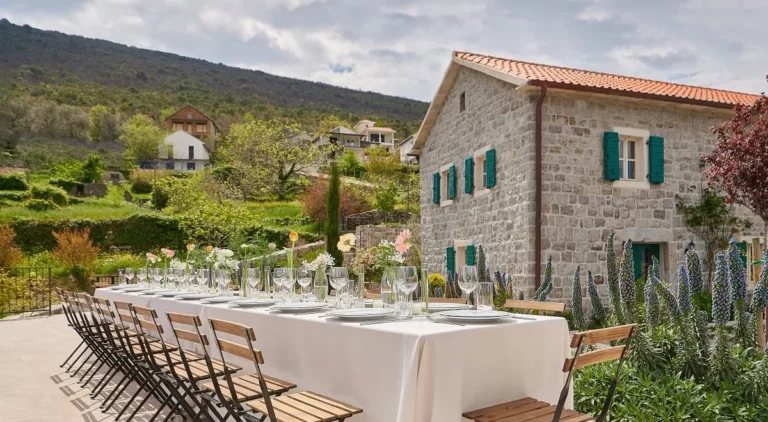
Villa Stari Mlin
A historic 400-year-old stone villa — once an olive mill — set on a hillside among centuries-old olive groves.

Almara Beach Club
A stylish, bohemian beach club on a secluded pebble beach with a relaxed Mediterranean feel.

The Chedi Luštica Bay
A luxury five-star hotel set directly on the marina promenade with access to the Adriatic.
Capacity: how many guests fit
Capacity on Luštica is distributed unevenly, and it should shape your guest list before the invitations go out. Published capacity and the number of guests you can actually seat with a dance floor are rarely the same figure on this peninsula — we work from the second one. 10–30 guests. The peninsula's most common format, and the one couples underestimate. Private villas and small residences where everyone sleeps on site and nobody drives anywhere at the end of the night — Villa Stari Mlin, private houses in Krašići and Klinci. 30–50 guests. Whole stone hamlets on Luštica, such as Klinci. Guests split between the property itself and apartments fifteen minutes away. 100–250 guests. In practice, Luštica Bay only. Anything above 250 cannot be seated on the peninsula at all — for numbers like that you want the Budva Riviera. There is a genuine gap between 50 and 100 guests: very few venues sit in that range. If your list is around 70, expect two or three realistic options and book them a year out.
Exclusive use and privacy
Privacy is what brings couples to Luštica. Almost every venue here can be taken on exclusive use, and that means the whole property: grounds, pool, every bedroom, the kitchen, the driveway. A function room inside somebody else's hotel is a different product entirely. What that changes in practice: no negotiating the music curfew with other guests, no roping off part of the grounds for photographs, no strangers at the pool with your family the next morning. The ceremony can start at six, because nothing has to be cleared for anyone else by four. Exclusive use costs meaningfully more than an evening venue hire, and it should be costed differently: accommodation for your group is inside that number, and it would otherwise be a separate line.
The wedding weekend
Exclusive use leads directly into the format Luštica does better than anywhere else on this coast : a three-day wedding. Friday: arrivals, dinner on the terrace, a swim. Saturday: ceremony and reception. Sunday: a slow breakfast, a boat to the Blue Cave or across to Mamula, goodbyes. Nobody has to relocate, and you never have to decide who gets invited to the "second day" — everyone is already there. It works precisely because the venue is isolated. The peninsula offers your guests no competing programme, so nobody peels off into their own plans.
Getting legally married on Luštica
Luštica is administratively split between two municipalities: the eastern part — Radovići, Krašići and Luštica Bay — belongs to Tivat, while the western part with Rose, Žanjice, Mirište and Klinci belongs to Herceg Novi. That determines where the paperwork is filed, which registrar (matičar) travels out to the ceremony, and what the off-site registration fee is — the two municipalities charge differently. The boundary runs roughly down the middle of the peninsula, and in our experience couples discover this only after they have chosen a venue. An off-site legal ceremony is possible on either side: the registrar comes to the venue with the register, the formal part takes about fifteen minutes, and a Montenegrin marriage is recognised across the EU, the UK and most other countries. You will need passports, birth certificates apostilled and translated into Montenegrin, a certificate of no impediment to marriage, and a court-appointed interpreter present at the ceremony itself. A symbolic ceremony requires no paperwork at all and can be held anywhere — including a rock above Žanjice that no registrar would ever reach. Plenty of couples sign the legal papers at home beforehand and keep Luštica purely symbolic. It is cheaper, faster and removes half the administrative stress. The town itself and the marina are covered separately — see wedding venues in Tivat.
Logistics: roads, boats and suppliers
Tivat airport to Luštica Bay is 25 minutes, to Klinci roughly 30, to Rose 50–60 — the last stretch is a narrow road cut into the hillside above the sea. Podgorica is 90–120 minutes, Dubrovnik around two and a half hours with a summer queue at the border. The Kamenari–Lepetane ferry is not needed for Luštica; the road runs overland through Tivat. There is one road along the peninsula, in places barely a lane and a half wide, with passing places. A fifty-seat coach will not get everywhere on it, so guests are usually moved in eight-seat minivans. It costs more than a single coach, and a convoy of minivans reaches the gates of the venue while a coach cannot turn around in every village. Boats work as transport here. Rose and Žanjice are quicker to reach by water from Tivat, Herceg Novi or Kotor than by road. A bride arriving by boat at a waterfront venue is a routine arrangement on this peninsula. There are no suppliers based on the peninsula itself. Florists, catering, sound, hair and make-up, hire equipment — all of it travels from Tivat or Kotor. Build that into both the budget and the timeline: crews arrive on site at least four hours before the ceremony, and everything has to be taken back out the same night.
When to get married on Luštica
The wedding season in Montenegro runs May to October, but the peninsula experiences it differently from the resort towns. May and early June. Everything is green, 22–26°C, the sea still cool, very few people about. The best window for the stone villages: in May the olive terraces look the way people picture them, and by August they are dry and burnt out. Late June to August. Hot, 30°C and above, warm sea. The peninsula stays noticeably quieter than its neighbours even at peak, but we do not put an outdoor ceremony at 3pm in August — six o'clock onwards only. September. The strongest month of the season, with the sea at its warmest after a summer of heating, the heat itself broken and a fraction of the visitors. September dates go 12–18 months ahead. October. The light turns golden, but the risk of jugo — the southerly that brings rain for two or three days at a stretch — rises sharply. For October we build the wet-weather plan in at the moment of booking. Wind is worth holding in mind all year: the bay side is sheltered, while the exposed western end at Rose and Žanjice catches both the bura and the jugo. A marquee or a covered alternative on that side is part of the brief.
What a Luštica wedding costs
Luštica is more expensive than Boka or Budva. The reason is structural: you pay for a whole property, usually across several days, and evening-only hire barely exists here. As a market guide: exclusive hire of a villa or stone hamlet ranges from a few thousand euros for a weekend at a smaller property to several tens of thousands for the larger ones in peak season. A resort wedding is priced differently again — a minimum spend per person plus hire of the spaces you use. Logistics is always its own line on Luštica: brought-in catering, minivan transfers, equipment from Tivat. Heavy styling is the one thing you can drop. Stone walls, olive trees and views onto two seas at once do the work themselves, and budget that would have gone on décor in a town is better moved into food and lighting. Real numbers depend on the date, the property and the guest count — send us your dates and we will price specific options.
Frequently asked questions
Can we take the whole venue?
Almost any private villa or stone hamlet on Luštica, yes — and usually it is the only format available, since these properties are not let in parts. At the resort, exclusive use applies to specific spaces rather than the whole hotel.
Is Luštica right for a small wedding?
It is arguably Montenegro's best region for one. Most venues here sit in the 20–50 guest range, several villas take exclusive-use bookings for groups of ten, and privacy costs nothing extra because the property is yours regardless.
How far do guests have to travel?
Twenty-five to thirty minutes from Tivat airport to most venues — closer than Kotor, Budva or Sveti Stefan. The furthest point is Rose, at around an hour.
Where do guests stay?
On site, if you have taken the property: from 10 beds at the smaller villas to 220 at The Chedi. Anyone who does not fit stays in apartments in Krašići or Radovići, 10–15 minutes away.
Where do we put the ceremony for a sunset?
On the western side — Rose, Žanjice, Mirište — where the sun drops into open water and the Adriatic views are unobstructed. On the bay side the sun sets behind the ridge, so the best light there arrives in the hour before sunset.
Can we legally marry at the venue?
Yes. Off-site registration works on both the Tivat and the Herceg Novi side of the peninsula; the fee and the filing process differ, and we confirm which applies once the venue is chosen.
How far ahead should we book?
May, September and the first half of October: 12–18 months. July and August: 8–12. There are few venues on the peninsula and rarely a substitute for the same date.
Tell us your date and we'll shortlist Luštica venues
We plan weddings in Montenegro every season and have walked every one of these venues ourselves. Send us your dates, an approximate guest count and what matters most — seclusion, a sunset ceremony, or having everyone sleep on site. We'll come back with three or four options, each with real capacity, real pricing and the honest limitations. We reply within a day.
You may also like:
Start planning your dream wedding
Tell us about the celebration you imagine — we reply within a day with a venue selection and a quote for your wedding dates. Get in touch and let Montenegro do the rest.