NeverEnd
Wedding Production Agency
Same-Sex Civil Partnership in Montenegro: A Guide for Foreign Couples
How two foreigners register a same-sex life partnership in Montenegro: eligibility, documents, timeline, the ceremony, your rights and where the partnership is recognised.

Contents
Still have questions?
We will look at your situation and send a quote for your format and dates.
Plan My Wedding →Checked on 14 November 2026. Municipal requirements and entry rules change, so we date every check and update this page.
The short answer: Montenegro does not perform same-sex marriages, but it registers same-sex life partnerships (životno partnerstvo), and your nationality does not matter. The law has applied since July 2021. Two foreigners with no residence in Montenegro file an application with the municipality, attend a short ceremony with the registrar a few weeks later and receive an extract from the partnership register the same day. The rights come close to marriage — inheritance, joint property, health insurance — with one gap: partners cannot adopt jointly.
This guide covers who can register, the documents, the ceremony, the rights a partnership gives you and where it is recognised once you are home. If you are an opposite-sex couple, see our page on a civil wedding in Montenegro.
Marriage or partnership: what Montenegro registers
Article 71 of the Montenegrin Constitution defines marriage as a union of a man and a woman, so same-sex couples enter a separate legal union. It was created by the Law on Life Partnership of Persons of the Same Sex (Zakon o životnom partnerstvu lica istog pola), published in the Official Gazette No. 67/2020. The law came into force on 15 July 2020 and became applicable a year later, on 15 July 2021.
The first partnership was registered in Budva on 25 July 2021. In the first year there were 22, eighteen of them in Budva, most between Russian citizens. By November 2023 the total had passed 75. Lawyers at LGBT Forum Progres say almost every couple they help with registration comes from abroad.
Montenegro was the third former Yugoslav country, after Slovenia and Croatia, to offer legal recognition to same-sex couples. What sets it apart for foreigners is that the law asks for no citizenship or residence.
Who can enter a life partnership
The conditions in Articles 8–11 mirror those for marriage:
- both partners are 18 or older;
- both consent freely and understand what they are signing;
- neither is married or in another registered partnership, in Montenegro or anywhere else;
- the partners are not close relatives, including by adoption.
Nationality, place of residence and length of stay play no role. Two German women, an Israeli and a Kazakh man, a British couple — all follow the same procedure.
If a condition is not met, the registrar tells the couple orally and issues a written refusal within three days. You can appeal to the municipality’s chief administrator within eight days, and the appeal is decided within five (Article 13).
Documents for a same-sex partnership
| Document | Issued by | What to do with it |
|---|---|---|
| Passports of both partners | — | copies when filing, originals at the ceremony |
| Birth certificates | civil registry of your country of birth | apostille and sworn translation |
| Certificate of single status (not married) | registry office, civil register or consulate of your country | apostille and translation, usually issued within the last 3 months |
| Proof of no existing registered partnership | the same, if your country keeps a partnership register | apostille and translation |
| Divorce decree or proof a previous partnership ended | if this is not your first union | apostille and translation |
| Registration of stay in Montenegro (prijava boravka) | your hotel or landlord | the tourist registration made within 24 hours of check-in; bring it to the registrar on arrival, before the ceremony |
| Passports of two witnesses | — | copies when filing, originals at the ceremony |
Two lines set a partnership apart from a marriage. Municipalities ask foreigners for the registration of stay as a separate document. A hotel registers you automatically; in a private rental the landlord must do it, so check if you stay with friends. The second is proof that you are not already in a partnership. Where a country has a partnership register — Germany, the Netherlands, the UK — you need an extract from it as well. Where it has none, the certificate of single status is enough.
How apostilles work in different countries, and what to do if your documents are already in Montenegro without one, is covered in our guide to marriage documents in Montenegro. The process is the same for a partnership.
Timeline: when to start
The law sets no notice period: the registrar fixes the date and time with the couple (Article 14). Municipalities set their own practice. Podgorica, for example, asks for documents at least 15 days before the date you want. We file 15 days ahead everywhere, which gives the registrar time to check the papers and confirm your date.
A realistic plan:
- 2–3 months before, order your certificates. The certificate of single status should be issued no more than three months before filing.
- 4–6 weeks before, have documents apostilled and send us scans.
- 15 days before, we file the application with the municipality — you do not need to be there.
- On the day, you and your partner meet the registrar. Arriving a day or two early is enough to sort out the registration of stay.
- 1–2 working days after, you collect the apostille on the extract, if your country needs one.
Russian and Belarusian citizens should start with the visa. From 1 November 2026 they need a Montenegrin visa or a valid Schengen or other recognised visa. Details are in our guide to Montenegro visa rules for wedding guests — the rules are the same for the couple.
Where and how the ceremony takes place
The partnership is registered by the registrar (matičar) of the municipality where you filed. By law the ceremony takes place in the official room, but on a justified request the registrar may allow another suitable place (Article 16): a villa terrace, a garden, a spot by the sea. The registrar decides, so we agree any outside ceremony in advance, when we file. Most partnerships are registered in Budva, Podgorica, Herceg Novi and Bar, and eleven municipalities publish application forms, Kotor, Cetinje, Kolašin and Nikšić among them.
The ceremony itself takes 15–20 minutes:
- the registrar checks the passports of both partners and the witnesses;
- an interpreter translates if you do not speak Montenegrin;
- the registrar asks each of you separately whether you consent;
- after two yeses, the registrar declares the partnership concluded;
- you, the witnesses and the registrar sign the register;
- you receive an extract from the register of life partnerships (izvod iz registra životnih partnerstava).
Any adult with legal capacity and a passport can be a witness. If you travel as a couple, we provide the witnesses. A sworn court interpreter is needed when either partner does not speak Montenegrin, and the interpreter’s name is entered in the register too (Article 33).
Couples who want a same-sex wedding with guests, vows and dinner combine the registration with a symbolic ceremony on the same day: the legal part in the morning, the celebration in the evening.
Choosing a surname
The surname choice is recorded at the ceremony, and the law offers four options (Article 17):
- each partner keeps their own surname;
- both take one partner’s surname;
- both take a double surname and decide which comes first;
- one partner adds the other’s surname to their own.
A foreigner’s name is written in the Latin alphabet, in their own language. Before choosing a double surname, check that your country will accept it: if it does not recognise the partnership, you cannot change your passport on the strength of a Montenegrin extract, and your documents will no longer match.
What rights a partnership gives you in Montenegro
The law puts partners on almost the same footing as spouses:
| Area | What partners get | Article |
|---|---|---|
| Inheritance | inherit from each other as spouses do | 66 |
| Property | anything earned during the partnership is joint; a property agreement is signed before a notary | 55–65 |
| Maintenance | a duty to support each other, including after dissolution | 46–51 |
| Health care | insurance and family-member rights equal to a spouse’s | 68 |
| Social welfare | the same benefits as a married family | 69 |
| Residence | the partner of a Montenegrin citizen or of a foreigner with residence can get a family reunification permit | 70 |
| A partner’s child | the right to make urgent decisions in the child’s interest | 53 |
The key difference from marriage: partners cannot adopt jointly or establish joint parenthood. Anything the law does not cover is settled under the Family Law by analogy.
These rights apply in Montenegro. For a couple who register and leave, they matter in two cases: if one of you lives here on a residence permit or plans to move, and if you own joint property here, such as an apartment. For everyone else, what counts is how your home country treats the partnership.
A partnership is dissolved through the courts, on one partner’s claim or on a joint proposal, which must include a written agreement on dividing joint property (Article 29).
Will your partnership be recognised at home?
The extract is an official document that can be apostilled under the 1961 Hague Convention. The apostille confirms the signature and seal; whether the union itself is recognised is up to each country.
| Country | How it treats a Montenegrin partnership |
|---|---|
| Germany | recognised as a registered life partnership (eingetragene Lebenspartnerschaft) under Article 17b of the Introductory Act to the Civil Code |
| United Kingdom | Montenegro is not on the Schedule 20 list of the Civil Partnership Act 2004. The partnership is treated as a UK civil partnership if it meets the Act’s general conditions (section 214), so check with a family lawyer before you register |
| United States | a same-sex marriage performed abroad counts for immigration. A civil union or partnership does not: USCIS does not treat it as a marriage, so it will not support a spouse visa or green card |
| Russia, Belarus, Serbia, Bosnia and Herzegovina | same-sex unions are neither registered nor recognised. The document has effect only in Montenegro and in countries that recognise such unions |
| Other EU countries | depends on national law. Where a country has its own partnerships or same-sex marriage, a foreign partnership is usually entered in its register through the civil registry or a consulate |
If you plan to use the partnership for your partner’s residence in another country, ask that country’s consulate in advance which document it needs and in what form. We prepare the extract with an apostille and translation to the requirements you send us.
How much it costs
| Item | Guide price | Paid to |
|---|---|---|
| Registration fee, official room | about €20 (Podgorica) | the municipality |
| Registration outside the official room | about €100 (Podgorica); other municipalities differ | the municipality |
| Apostille on a document at home | €30–80 | your own authority |
| Sworn translation of a document | €100–150 | the translator |
| Interpreter at the ceremony | about €50 per hour | the interpreter |
| NeverEnd support | see our prices | us |
Documents and registration together usually come to €350–600, depending on how many documents you have and whether the extract needs an apostille.
Step by step
- Tell us which passports you both hold and the month you have in mind. We build a document list for each of you.
- Order your certificates at home and have them apostilled.
- Send us scans. We check name spellings and validity dates while there is still time to reissue.
- Choose the municipality and setting: the registrar’s room or an outside ceremony.
- We file the application 15 days before the date, without you needing to be there.
- Fly in a day or two early and get your registration of stay.
- The ceremony, signatures, the extract the same day — and, if needed, the apostille and translation before you fly home.
Questions couples ask
Is same-sex marriage legal in Montenegro?
No. The Constitution defines marriage as a union of a man and a woman. Same-sex couples register a life partnership, which carries rights close to marriage.
Can two foreigners who do not live in Montenegro register a partnership?
Yes. The law requires neither citizenship nor residence. You only need the registration of stay for your trip, which your hotel makes.
How long do we need to stay in Montenegro?
Arriving a day or two before the ceremony is enough. Add one or two working days afterwards if you need an apostille on the extract.
Can we have the ceremony at a villa or by the sea?
Yes, if the registrar approves. The law sets the official room as the default and allows another place on a justified request, at a higher fee.
Do we need witnesses?
Yes, two. Any adult with legal capacity and a passport will do, and if you travel as a couple we provide them.
What document do we get?
An extract from the register of life partnerships, issued right after the ceremony. A court adds the apostille within one or two working days.
Will our partnership be recognised in our home country?
It depends on the country. Germany recognises it as a registered partnership, the US does not count it as a marriage for immigration, and Russia and Belarus do not recognise same-sex unions. See the table above.
Can we share a surname?
Yes. You can keep your own names, take one partner’s surname, take a double surname, or add your partner’s surname to yours.
How is a Montenegrin partnership dissolved?
Through a Montenegrin court, on one partner’s claim or on a joint proposal with an agreement on dividing property.
Does a partnership give the right to live in Montenegro?
Yes, if your partner is a Montenegrin citizen or a foreigner with a residence permit. You can then apply for residence on family reunification grounds.
Official sources
- Law on Life Partnership of Persons of the Same Sex (Zakon o životnom partnerstvu lica istog pola), Official Gazette 67/2020: Arts 8–11 — conditions; Art. 12 — application to the local authority; Art. 13 — refusal and appeal; Art. 14 — date set by the registrar with the couple; Art. 16 — official room, another place on a justified request, two witnesses; Art. 17 — the ceremony and choice of surname; Art. 18 — entry in the register and same-day extract; Art. 29 — dissolution through the courts; Art. 33 — interpreter recorded in the register; Art. 66 — inheritance; Arts 68–70 — health care, welfare, residence. Text on gov.me · text and municipal forms on partnerstvo.lgbtprogres.me
- Constitution of Montenegro, Art. 71 — marriage between a man and a woman.
- Germany: Introductory Act to the Civil Code (EGBGB), Art. 17b.
- United Kingdom: Civil Partnership Act 2004, Part 5, Chapter 2 and Schedule 20.
- United States: USCIS Policy Manual, Vol. 12, Part G, Chapter 2.
Tell us where you are from
Tell us which countries you are both citizens of and when you would like to register your partnership. We will send a document list for your passports, tell you whether your country recognises the union, and suggest a municipality and setting for the ceremony.
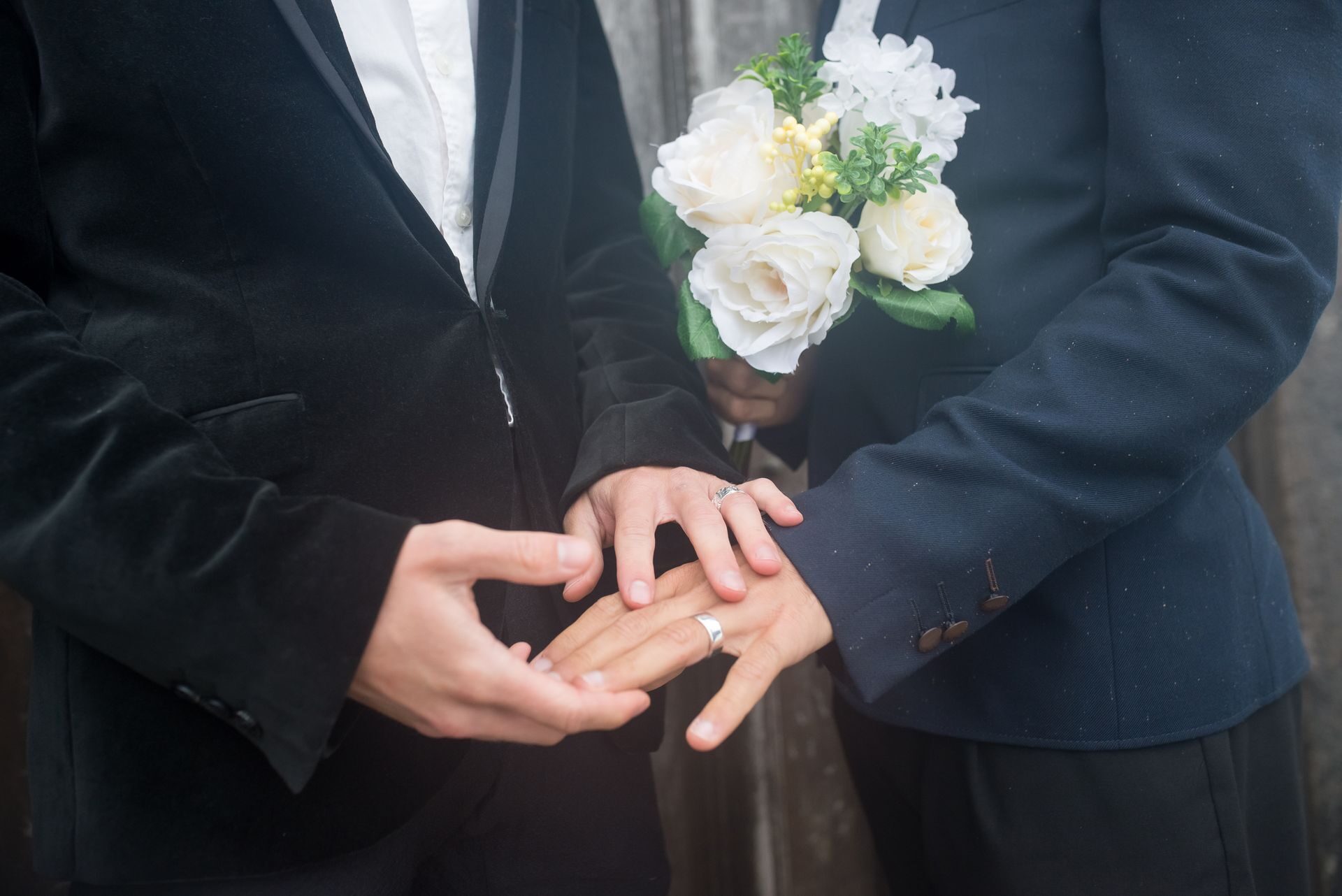
Cover photo: Kampus Production, Pexels.
(Contact)
Start planning your dream wedding
Tell us about the celebration you imagine — we reply within a day with a venue selection and a quote for your wedding dates. Get in touch and let Montenegro do the rest.